Monday, 19 January 2015

Heidelberg Joins Increasing Number of InPrint Show Exhibitors as Industrial Print Booms

Heidelberg Joins Increasing Number of InPrint Show Exhibitors as Industrial Print Booms


J. Oliver 130118-25
Jason Oliver, VP, Digital Inkjet, Heidelberg
InPrint Show organisers, FM Brooks, have reported a significant number of bookings from new exhibiting companies for the second edition of InPrint which takes place 10-12 November 2015 at Messe Munich International Trade Fair Centre, alongside Productronica.
One of the companies to recently confirm participation is Heidelberg, who are developing industrial print solutions and participating at InPrint as the core focus for these innovative technologies for industrial printing.
Jason Oliver, VP of Digital Inkjet, explains why Heidelberg is taking part in the show: “Heidelberg sees a very positive future for inkjet particularly in the industrial print sector so it is a logical move to be part of the next InPrint Show in Munich. The successful establishment of InPrint as the show for future industrial print technologies synchronises perfectly with Heidelberg’s vision for inkjet. We have plans to launch exciting new systems for customers decorating 3D objects – we call this ’4D Printing’.”
Frazer Chesterman, InPrint Co-Director continues, “The industrial print sector is clearly booming and the market already sees InPrint as the exhibition for print technology for manufacturing. We are delighted that some of the biggest names such as Heidelberg are making InPrint their main platform in 2015. This means that not only will InPrint be a larger exhibition than our launch show, it will also feature the most innovative technologies available in the industrial print market today and in the future.”
Nearly 40 new exhibitors have signed up for InPrint 2015 including: Heidelberg, KBA, Konica Minolta, Kyocera, Wifag Polytype, Wikoff Inks, Collins Inkjet, Seiko, Tonejet, Archipelago, JetSet, KNF, Onyx, Lüscher, OMSO, Amica, Afford, Inometa, Staedtler, Grafco, GEW, Adphos, Alchemie, D&K, Inca, Ushio, Roos, Bordeaux Digital Inks, Ruco Inks, Sirpi, Polychromal, Stiefel, Natgraph, Technoplot, Kimoto, MacDermid Autotype, Global Inkjet Systems, and Tiger Coatings.
InPrint 2015 will take place at Messe Munich, a prestigious European venue for highly successful manufacturing trade shows. In 2015, InPrint is co-located with Productronica, the exhibition for electronic manufacturing. Productronica will cover 7 halls at Messe Munich, attracting over 50,000 global visitors.
Co-Director Marcus Timson continues, “The new location in Munich gives easier access for visitors from key industrial regions in Germany, Italy, Austria, Czech Republic, Poland and Switzerland and and it is perfectly positioned for visitors across the globe. The added benefit of co-location with Productronica provides InPrint visitors with even more value. We are excited about the next edition of the show and look forward to the undoubted success of InPrint 2015.”
In the latest InPrint White Paper ‘Why is Industrial Print Booming’? – highlights key drivers and trends for growth in industrial print and argues that Europe, in particular, is set to benefit from a continually changing consumer and manufacturing landscape.
InPrint Research Executive Summary
At InPrint 2014, 6,995 people from 63 countries attended. 52.8% were from the manufacturing sector. This in itself distinguishes InPrint from any other event in the print show calendar. Attending companies came from a wide spectrum of the market from packaging to pharmaceutical, from automobile to interior décor. In addition visitors attended from the entire supply chain from famous large brands as well as tier 1 and 2 industrial print production companies and technology developers and integrators. Visitors held senior strategic and technical positions within their businesses, with over 70% holding board level or skilled worker status. The leading motive for attending InPrint is to discover technology that creates new value/revenue/performance for manufacturing output, and for customised technologies designed collaboratively. In contrast to traditional print shows, the concern for improving efficiency whilst in the top 5 motives, this was not as important to visitors as discovering innovation that enables new revenue creation.
ENDS
For a full exhibitor list, floorplan, white paper and 24pp InPrint Show Report and Market Analysis, please contact marcus.timson@mackbrooks.com
InPrint Facts
  • InPrint is the exhibition focused upon industrial print technologies for manufacturing.
  • InPrint is the only print exhibition attended predominantly by professionals from the manufacturing sector.
  • InPrint 2015 primarily showcases technologies for screen, speciality, digital, inkjet and 3D printing.
  • At InPrint 2015, 150 exhibiting companies will showcase innovative solutions for industrial print production.
  • InPrint’s main application segments include functional, decorative and packaging printing.
  • InPrint attracts senior decision makers who attend to solve specific production problems
  • InPrint visitors want customised innovation and expertise that will generate new possibilities in production.
  • InPrint 2015 will be co-located with Productronica, the leading tradeshow for electronics manufacturing

The Wedding Invitation

Purpose


The wedding invitation informs your guests of the date, time, place and hosts of the wedding ceremony and is typically sent out 4-6 months ahead of time.
Send one wedding invitation per couple. Children under the age of 18 may be included on the parents' invitation. Older children, especially those not living at home, should receive their own invitations. If you are not allowing children at your wedding under a certain age, be sure to also specify that in your invitation.
For single guests, send one invite. You may write "and guest" on the inner envelope if giving that option, or send a separate invitation to the guest's date.
How many invitations do you need? Many people often think that if you are inviting 300 people, that means you need to order 300 invitations. Not true. In reality, you would only need to order around 150. Make sure to include to account for 10-15 extra for omissions, keepsakes, 'courtesy invites', and mishaps during assembly.
Some of the things to consider when preparing and choosing your invitations include:

Insider Access

Insider Access: Chris Bear, Head Of Multimedia Studio & Print Production

chris-bear-profile
Chris Bear has seen his fair share of change over the years of his career, and in his current role as Clemenger BBDO Sydney’s Head of Multimedia Studio and Print Production, he has a commanding view over the changes affecting the technology, skills and people within the world of advertising.
Chris started his career on the other side of the publisher-advertiser divide, as a retoucher for a magazine, before moving to manage a team of 25 at Pacific Magazine’s Pre-Press department. After 6 years, he found himself considering a career shift into advertising production.
 “When you are flicking through a magazine, and you start looking more at the advertising as opposed to the magazine, that was the switch for me,” Chris said.
Chris eventually landing a job running the print production department at Ogilvy, and after 8 years in that role, moved over to Clemenger.
For Chris, ad production is a passion, and the challenge of execution is the spice of his career.
“Someone coming up with an idea, and you actually having to execute that idea, was inspiring to me,” he explained. “You have to source, you have to get the right internal and external partnerships happening, to a deadline and budget.”
And sometimes, you get to mix with some real characters during ad production. Particularly memorable for Chris was the SportingBet campaign where he got to work with Shane Warne, pitting him against a spider, the world’s hottest curry, and a kickboxer.


A Revolutionary Evolution of Print

JL 2015
By Joseph Lyman
President
Great Lakes Graphics Association
If I had a nickel for every time I heard someone say, “Print is Dead” over the past several years, I would be a millionaire. There is no questioning that the industry has faced some tough times for nearly a decade, causing every owner to restructure their business. Print buyers are extremely discerning about how they budget their money to communicate their message, and it has come at the expense of print sales. The short of it is that the Internet and electronic marketing have put downward pressure on the revenue for some of the work that used to go to commercial print.
However, there is an emerging market that could be a boon for the industry. Organic light emitting diode (OLED) and electronic component printing using electrically conductive ink is showing extreme promise as a new technology that could supplant how many different electronic products are currently manufactured. This is reinforced by the Wall Street Journal’s recent article featuring R.R. Donnelley and its increased efforts to use the printing process to manufacture electronic components. Although not perfected, early results prove that everything from RFID chips to solar and lighting panels to OLED touch screens and televisions can be printed using existing yet improved printing processes.
Much more research and development will need to be performed, and it will take a host of different players (chemists, electrical engineers, equipment and ink vendors and many others) working together to perfect the process. However, it has been proven that by using the printing process to manufacture a product, it could provide an opportunity to not only achieve mass production but also drive the price of electronic component manufacturing down.
What does this mean for traditional printers? Well, just like the printers that decided to expand their businesses to include wide format inkjet and digital toner printing, the industry will see more printers expand their businesses yet again to offer OLED and electronic component printing. However, this time the industry will not experience printers using a different form of technology to manufacture the same type of commercial print product. Instead, printers will be fighting with electronic component manufacturers to replace a manufacturing process that has been used for decades.
Many times over the years, printers have evolved to expand the types of print they offer to customers. There is no doubt that if processes are improved, printers will again evolve to manufacture even more and diverse lines of products.
Joseph is President and CEO of the Great Lakes Graphics Association. The Great Lakes Graphics Association is the trade association dedicated to representing the graphic arts industry throughout Illinois, Indiana and Wisconsin through education, promotion, and public affairs. GLGA is headquartered in Pewaukee, WI, with state directors based in Illinois, Indiana and Wisconsin, and is an affiliate of the Printing Industries of America.

Logo: an image worth a thousand words as identity

Your logo is your first chance at a good impression. Every detail matters, so you have to make it count. We have an understanding of the conscious and subconscious meanings of symbols, shapes, letter forms and colors, all of which act at a psychological level to determine how your brand is perceived.www.phdng.com

Your business is more than just a symbol or a font; it requires a personality customers can relate to. It means finding the identity that perfectly matches your corporate values and your product offering.

 A logo represent your business and your personality, make it special.

Sunday, 11 January 2015

Check out the latest offers

http://www.konga.com/?k_id=phdoffers

Business Cards


Why aren’t you using this inexpensive marketing tool?

You might say, “how is a business card going to do to help your business grow”…positively and possibly more than you think. One of the most cost effective ways to promote your business is through the use of a professional business card that not only looks good, but get’s peoples attention and gets them to keep your card while they may throw others away.

Get the most out of your business cards by designing them with marketing in mind.

Business cards are the most popular marketing tool of small business – they’re portable, affordable and people actually expect you to have one! Yet most business cards wind up in the trash the day they’re received. Business card design is more than just a great looking card, it also includes text as well. To get the most from your business card, you need to design them with marketing in mind. Instead of doing the typical card that states your name, company name, address, phone, fax and maybe email – try to give people a reason to do business with you or possibly even an offer that gains their interest immediately. Contact us to see how our in-house designers can help your business stand out from the rest. Have a profitable 2015.

Saturday, 27 December 2014

CHALLENGES FOR THE PRINTING INDUSTRY GLOBALLY THE ROAD AHEAD - CREATE THE OPPORTUNITY in 2015

Managing Partner at Cavendish - ► CEO, business coach & author ► Helping companies achieve growth
Industrial Market Review and Outlook for 2015

Fast Forward to the Future

It is also indicative of the elevated risks facing the world economy in 2015 and beyond. Global or should I say Asia growth remains robust and oil and commodity prices will rise to high levels (yes they will rise again)! With output gaps shrinking or closed, inflation is `real` so start planning for the future. Plus, when will commodity prices stop rising? Yes, they will continue to rise in the future, rapidly!

In particular, labour and housing markets are still fragile against the 2007 employment and prices. In time, there will be rising rates which will `impact` on consumer spending globally. Yes, the boom and bust is back again!

The future is about offering `solutions` to customers by operating a Print and Workflow Solutions Programme and methodically looking at how you manage your business with the `right` people and business models. Also, keeping a close eye on the speed of change, that will affect your business. Training, business models, business guides, and experienced/skilled people of any age that are available to help your business challenge the global impact are the most important investment for your success.

In the world of the year 2015 will continue to fight Ebola/Vladimir Putin/Islamic State Terrorism and many more challenges. Western Europe is back in an economic rut/Japan`s recovery is faltering big time/China looks as if its heading for its slowest growth since 1990. There are good things happening too, Like, many challenges they are continuous year by year and we all have to look at new ways to recover and bring growth globally. Everyone should read history and then we could plan better for the future!

Be positive, have passion to be successful and have a `strategy` for this rapid change globally.

What is your strategy to survive and be successful?

Nanography New Page For Effective And Profitable Printing?

Nanography printing combines the characteristics of offset printing with the flexibility of digital printing. No longer do we have to choose between the versatility of digital printing and a low cost per page and high productivity of offset printing. With nanography we get both.

short evolution of nanography.

We are surrounded by different offset printings with annual incomes in the world of approximately 800 billion dollars.
Digital printing is fast replacing many traditional printed products. What does this mean for the future? Nowadays digital printing takes a very small percentage of the total revenue. To be truly able to take a larger slice of the pie, digital printing has to be competitive in terms of quality, speed, cost, size format and the ability to print on all kinds of material.
nano printing
nano printing
Today, the industry offers devices capable of printing on almost all materials, and digital printing is experiencing explosive growth of income. Currently, there are approximately around 50 billion pages that are annually printed worldwide, of which only 2% are printed with digital techniques.
Nanography is preparing a revolution (at least so they say) and wants to take the lead in the field of printing between 5000-30000 pages. Classical techniques of digital printing can not match the price and speed of offset machines in this segment of printing. The nanography will try to change this.

komori and efi jumped into the game.

After presenting the project at Drupa 2012, Landa group continued with the development of technology and the development of the first commercial devices Landa S10 in the last quarter of 2014. A hundred test device is already in use and scientists from Landa groups are working on their enhancements based on customer experiences. The seriousness of the project is confirmed by reputable companies that are involved in the project of Nanography.
The production of nanographic printing devices takes over a prominent global manufacturer of printing presses Komori from Japan. Landa group will deliver technology and ink and Komori will deliver hardware. The company EFI Fiery is also involved in this project with rip software to help nanographic printing devices. The newest is that the specialty chemicals Group Altana invests US $135 million in Landa Digital Printing.
landa s10 nanographic b1digital printing pres

the working principle of nanography.

At nanography it comes to an inkjet-system that works with special “nanoink” inks. These water based inks are used pigments with dimensions of only a few nanometers and at the same time has excellent absorption and remission of light. According to the manufacturer, with this ink we can get very sharp, tiny screens.
Extremely lifelike color prints are enabled by using a larger CMYK color range than it was possible by using the previous printing technology. With the ink thickness of only half a micrometer, this procedure gets a much thinner layer of ink than with offset printing which in turn results in lower cost of printing. This is aggravated by the fact that for the transfer of the image needs no further transfer medium, such as a plate in offset-printing, no additional treatment of the surface on which the print is transmitted.
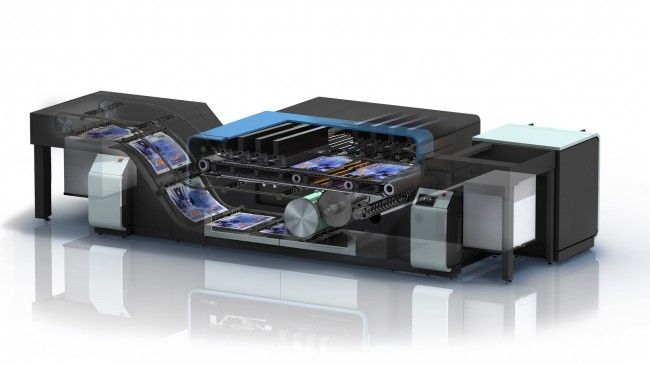
The procedure of printing is relatively simple. By using up to eight colors, the negative with Inkjet ejectors (which are very similar heads) is applied to a heated rubber roller. Because ink contains very little water, it immediately evaporates on contact with the heated roller and remains only 500 nanometers thick film that is, without any residue, transferred directly to the paper. In this procedure paper is not heated, but only roller, so the paper can immediately continue with the rest phases in production.
The polymer film when transmitting only slightly enters into the structure of the media on which is transferred because virtually is free of moisture. Nevertheless, it sticks, similar to the label, on almost any surface. Thus, it is possible to print not only on paper, but also on the surfaces without absorption properties. It is possible, therefore print on cheaper materials, without loss of print quality.

Tuesday, 2 December 2014

Five Reasons Why a Valuation is so Incredibly Valuable

Five Reasons Why a Valuation is so Incredibly Valuable
Everyone knows a business valuation is needed when it’s time to sell a business.  But the specifics of why it’s necessary, and specifically how it can be used, are often misunderstood. These five insights will help you identify why a business valuation is so critical.
This post was inspired by a tremendous article written on Forbes.com by Steve Parrish.  In this article, he lists why a business valuation is so important. I’m going to paraphrase Steve’s insightful checklist, and add a few thoughts of my own. 
Before I do, keep in mind that we’re talking about an independent business valuation, not some financials that your accountant or CFO put together.  Only by using an independent appraiser can you provide credible financials that all parties can agree upon (albeit sometimes grudgingly). 
With that point in mind, here are the reasons why your business should value a business valuation:
1. Someone else will conduct one anyway.  The business valuation is part science, part art.  In other words, there is some subjectivity to it.  If a bank or even (gulp) the IRS needs to run their own business valuation, you may not like the results.
As Parrish notes, if you’re selling or willing your business to your heirs, “The IRS may have an interest in valuing your business.  In many cases, their valuation will be comparatively high, simply because a higher value means more tax revenue.
2. Your buyer may produce a questionable valuation.  If you are in the process of selling your business, a potential buyer may produce a valuation geared to their best interests. 
It could be a lower value, naturally, but as Parrish notes, it could also be a higher amount, offered “in anticipation that some of valuation premiums will be recovered through earn-out provisions.”
Everyone has a vested interest in that number.  Using an appraiser that is truly independent removes the subjective nature of the exercise.
iStock_000017708307_Small
3. You can develop your retirement roadmap.  We blog repeatedly about how so many business owners are not ready for retirement.  The biggest reason? They simply don’t know how much money they’ll have for their golden years.
Why? Because they simply have no idea how much their company is worth. Even if you’re not planning on retiring in the next year or so, an independent valuation can give you a sense of how much money will be waiting for you down the line.  This affects your retirement, your estate planning, everything.
4. You can shape your company strategy.  Parrish brings up a good point about how a valuation can be used to shape your operation in many ways.  For example, if you want to create a unique compensation plan, a valuation can give you the parameters.
“You now have a baseline value to use in deferred compensation arrangements, such as phantom stock and stock appreciation rights (SAR) plans,” he writes.
5. You can solve legal issues before they happen.  Parrish also notes a valuation acts as a security measure to protect you if legal issues arise.  For family businesses, he cites the instance of a family taking a case to the supreme court because of a discrepancy in the business valuation.
Establishing the value upfront can limit much political infighting and uncertainty in a situation.  Yet it can only be accomplished if the appraisal is conducted by an independent party.